
Review: THE SHADOW OVER PSYCHE STATION by Yuval Kordov

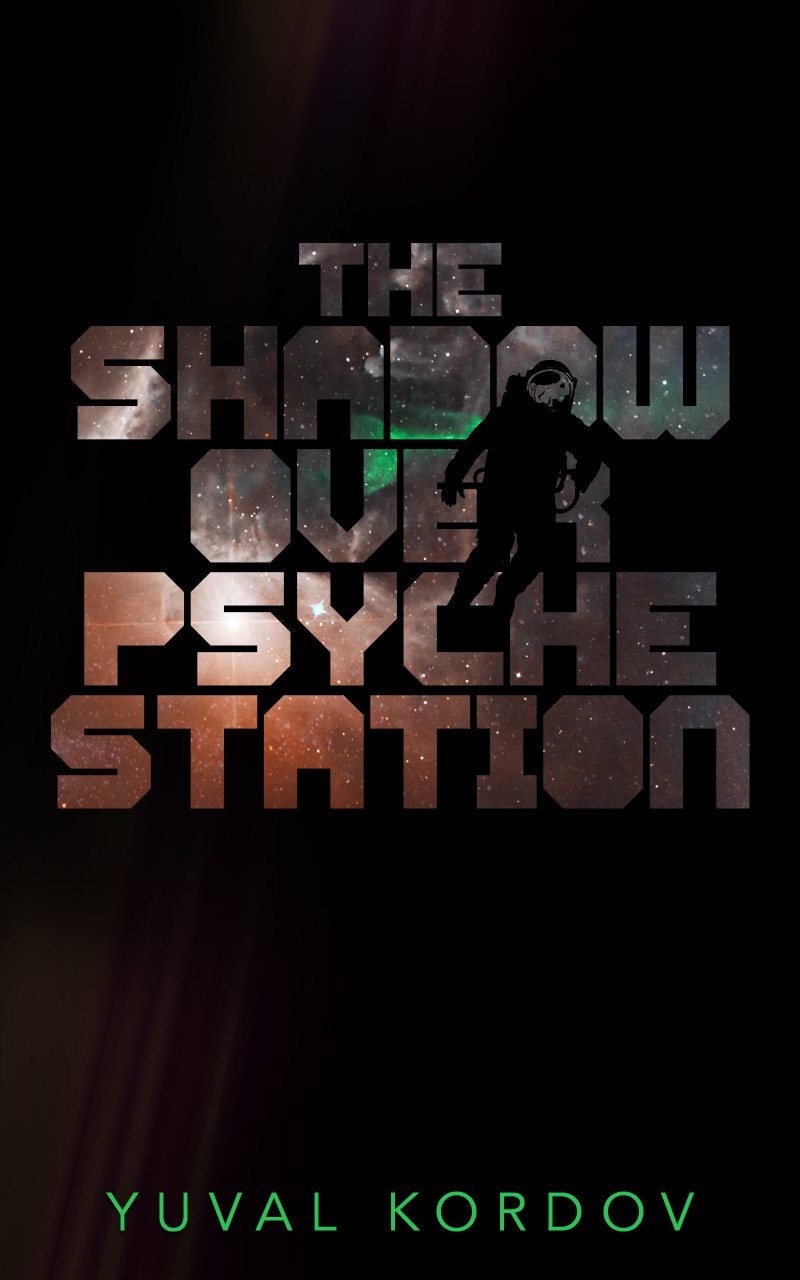
Disclosure: I was provided a digital copy of this book by the author.
“Space is the event horizon between Creation and uncreation. The void in which foul things linger.”1
Yuval Kordov is, to state as plainly as possible, an artisan with words.
I’ve been a fan of Kordov’s writing ever since I first encountered it in 2023’s The Hand of God; and longtime followers of the blog might recognize Kordov’s name as that of the editor of my short story The Last Flight for Incensepunk Magazine.
The Shadow Over Psyche Station is, as fans of the genre will probably already have discerned from the title, a sci-fi reimagining of H.P. Lovecraft’s The Shadow Over Innsmouth. The presence of Lovecraft’s influence in Kordov’s work should not surprise any of us who’ve read his canon (I saw shades of Lovecraft’s The Festival in Kordov’s The World to Come); but there are a lot more influences we could discuss—just to give you an idea of the texture of the novel. As with Kordov’s Orders of Magnitude, the pull of Event Horizon’s gravity is strong here; and, as with Event Horizon, Kordov’s depiction of deep space strikes a similar tone to that which Milton describes Hell in Paradise Lost:
Seest thou yon dreary plain, forlorn and wild,
The seat of desolation, void of light2
In my SFF Insiders review of Kordov’s Orders of Magnitude I mentioned Neill Blomkamp’s Demonic, which I bring up here in order to say that Psyche Station has echoes of another Blomkamp work: his 2017 Oats Studios-produced short Zygote. There’s bits of Jeff VanderMeer’s works all throughout Psyche Station, and fragments of Lem’s Solaris (Psyche appears, at times, as the malevolent inversion of Lem’s titular planet), Clarke’s 2001 and 2010, Crichton’s Sphere, and Bradbury’s The Illustrated Man (chiefly the stories “Kaleidoscope” and “No Particular Night or Morning”); and Psyche Station bears a similar melancholy to that found in James Tiptree Jr.’s “Mother in the Sky with Diamonds” (in 10,000 Light Years From Home). But, perhaps my most important point of comparison—for those exact kind of sickos like me: if you’ve ever wanted a book that felt like the opening hours of exploring the USG Ishimura in Dead Space, this is the book.
The story of Psyche Station follows Marcus O., an assessor for the Martian empire, assigned to check out one of the empire’s distant stations in the asteroid belt; a station which has been aggressively delinquent in its scheduled ore shipments back the Red Planet. Additionally, eyewitness reports of what’s been going on in and around the station have been… worrisome. And there’s your setup. Are these simply space-OSHA violations… or something else?
Though it begins slowly, methodically laying out the setting and Marcus’ motivations, the story of Psyche Station is taut and—for lack of anything more flowery—page-turnable. I breezed through the book in two sittings, and its gradual build-up leads to a series of wild conclusory chapters that left my palms sweaty. Though not nearly as bombastic as any of Kordov’s previous works, Psyche Station thrives on its atmosphere (especially when Marcus’ own is in short supply). It is grimy and claustrophobic (in the style of my dearly beloved Alien), and Kordov makes sure that all of Marcus’ senses are captured on the page: with special attention paid to smell.
As one might expect from a story like this, there are few properly human characters in the story, but some of my favorite moments came from Marcus’ interactions with Psyche’s survivors. One in particular, a priest still clinging to his vocation amidst the darkness, provides two of the best moments in the book (one that nearly made me SCREAM with excitement when I realized what was happening). It’s great stuff. There’s a whole scene with Marcus attending a mass given by this priest which is one of my favorite chapters in a book—a very human experience that anchors the characters as real people. All too often stories like this can present their characters simply as two-dimensional vehicles for exciting story beats, but Kordov always puts in the work to make his characters feel like fully developed, real persons (relatedly, one might assume that this is why Kordov never shies away from documenting, in detail, how his characters relieve themselves—Marcus has two of these scenes before the main action begins).
And of course, not all the characters in a setting such as this need be flesh and blood. Perhaps my favorite element of the book is Kordov’s inclusion of a mysterious, illicit AI system aboard the woe-begotten station. The Martian empire appears to be right on the edge of their own Butlerian Jihad, as we learn that it is illegal to use “processing power to simulate a human being;”3 And Marcus later muses that “The station mainframe couldn’t be trusted, not fully, given the artificial intelligence poisoning its circuits”4 (my emphasis). The way the AI manifests itself evokes the same kind of philosophical explorations found in Do Androids Dream of Electric Sheep? and in its filmic sequel Blade Runner 2049. The AI is there to fulfill Marcus’ needs and desires, whatever they may be. Is this not how generative AI is being sold to us right now? To make things easier, to lift our burdens and free us from the turmoil of thinking for ourselves? Give yourself to the computer, it will keep you safe. It will provide you comfort and solace. The acronym by which the Kordov’s AI system is named is delightfully on the nose (it made me laugh out loud—complimentary!), but I will leave it to readers to discover.
Broadly, The Shadow Over Psyche Station explores an idea I’ve thought about often in my own work, and an idea Kordov himself has explored elsewhere in his fiction—the idea of deep space as being anathema to our human connection to God. In Orders of Magnitude, a comparison is drawn between the Moon and the Tower of Babel (though in the Dark Legacies books space doesn’t seem to exist at all—just a pitch black, moonless night sky over the Earth; an aesthetically different but no less thematically similar separation from God, the vanishing of “the heavens” leaving us all alone on the Earth); but in Psyche Station the comparison between settings is not so explicit. It is simply distance—absence from the comforting shelter of Mother Earth, from the place that was created for us. What evils might we encounter the further we remove ourselves from that home? Does the atmosphere of Earth provide us with spiritual protection as well as physical? Perhaps there is only one way to know for sure. Psyche Station’s characters seem to already know: “Space is not empty,” says Psyche’s priest. “It is full. Of evil.”5 We might especially worry when this priest tells Marcus that the rest of the station’s occupants “go outside to pray now.”6
For those completely unfamiliar with Kordov’s work, I think I’d recommend starting here—as Psyche Station is, in my opinion, the most straightforward of his books. Marcus O. is just a guy trying to do his job—not quite so blue-collar as many archetypal heroes of the genre, but as far as motivations go it’s about as simple as they come. Unfortunately for Marcus, his job is taking him to the edge of explored space, to the darkest pocket of the asteroid belt. But, for how relatively straightforward the narrative is, that does not mean it is without clever design. Though it felt like the closing chapters were leading towards an ambiguous ending—which wouldn’t have bothered me—the epilogue brought all Psyche Station’s loose story threads back together, just in time for one final punch to the gut.
All-in-all, a big recommend here from me (no surprise!). You can secure a copy of the book for yourself on March 31!
Kordov, Yuval. The Shadow Over Psyche Station. 2026 (ebook, pg. 105). You’ll likely find these and the below citations on slightly different pages, I was reading this on my phone.
Milton, John. Paradise Lost. Edited and with an Introduction and Notes by John Leonard. Penguin Books, 2000 (pg. 7)
The Shadow Over Psyche Station, ebook pg. 43
ibid. ebook pg. 77
ibid. ebook pg. 104
ibid. ebook pg. 94