

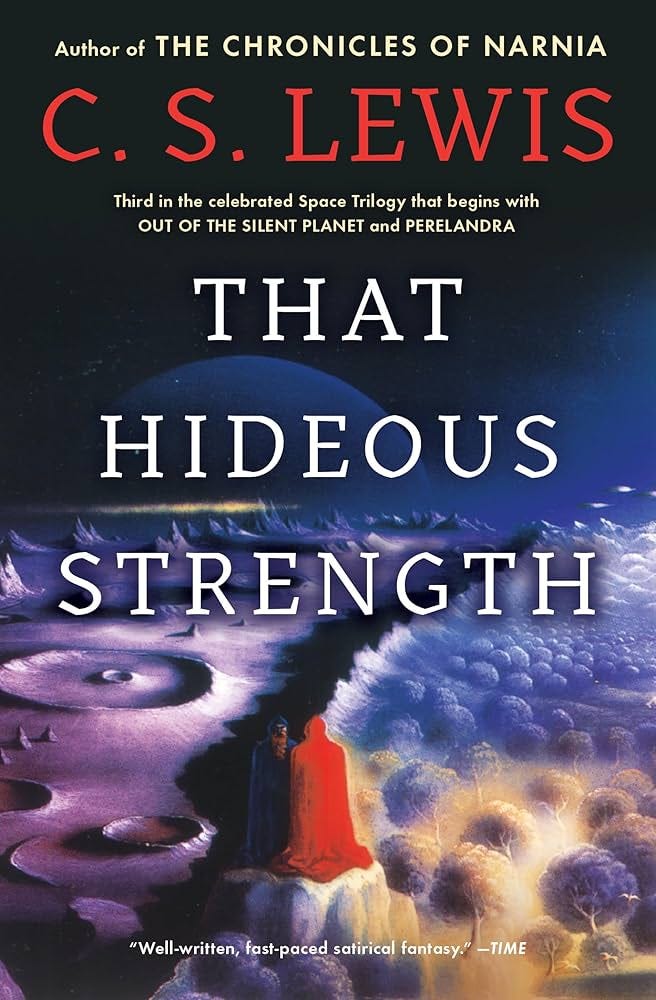
And now for the grand finale, concluding my reviews of the Space trilogy, which began with Out of the Silent Planet and Perelandra.
In the reviews of the previous two books in this series, I have compared Out of the Silent Planet to the works of H.G. Wells and Jules Verne, and Perelandra to Milton’s masterwork Paradise Lost. Where then does That Hideous Strength take its inspiration? Well, unlike The Silent Planet and Perelandra, which are big, sprawling explorations of worlds beyond ours; That Hideous Strength is a decidedly terrestrial book. It takes place entirely on Earth, and entirely in England. And in the grand tradition of 20th century English authors, it is a tale of dystopia. In a 1942 essay, I think Lewis well outlines the ideas underpinning That Hideous Strength:
To preserve civilization has been the great aim; the collapse of civilization, the great bugbear. Peace, a high standard of life, hygiene, transports, science and amusement—all these, which are what we usually mean by civilization, have been our ends. …As far as peace (which is one ingredient in our idea of civilization) is concerned, I think many would now agree that a foreign policy dominated by desire for peace is one of the many roads that lead to war. And was civilization ever seriously engaged until civilization became the exclusive aim of human activity?1
Departing further from the alien landscapes of Out of the Silent Planet and Perelandra, Ransom, our protagonist through the previous two books, is conspicuously absent from the early chapters of That Hideous Strength. Instead, we have two new protagonists: Mark and Jane, a husband and wife duo caught at the center of the battle that has been looming at the periphery of the two preceding stories. Mark is a professor at Bracton College, and via his university connections he becomes involved with the National Institute of Co-ordinated Experiments (N.I.C.E.), a multinational organization whose goals are to manifest “a better world.”2
Jane, Mark’s wife, is not so directly involved in the key events of the story, but is roped into the battle when it is discovered that she has a precognitive ability by which she can see the future, albeit somewhat abstractedly, through her dreams. This precognition is jealously sought after by the N.I.C.E.
Via these two interlocking story threads, That Hideous Strength is less a science-fiction novel and much more akin, in my mind, to a political thriller. Mark’s story, especially, exists within a slowly tightening noose—he is a mostly “normal” man who is brought into a world that he doesn’t fully understand and cannot properly defend himself against until it is too late (in similar intensity to something like Grisham’s The Firm). I found myself thinking a lot while I was reading That Hideous Strength about Aldous Huxley’s Brave New World, which came out 13 years prior. I know from reading Lewis’ Of Other Worlds that he had read Brave New World,3 but whether that reading occurred before or after the writing of That Hideous Strength I can’t say for sure, only that they share some aesthetic qualities. There is a specific invocation of a “Huxley” within the text of That Hideous Strength, but these seem to be references to English biologist Thomas Henry Huxley4 rather than Aldous. Similarly, I found myself wondering how, if it all, Lewis’ work might have influenced Orwell’s 1984, which came out 4 years later (I know Orwell read it because he reviewed it for The Manchester Evening News, but was he inspired by it?).
All this to say, were it not for how That Hideous Strength ends, I think it would’ve been my favorite of the trilogy. Everything prior to the ending is deliciously tense, that kind of overwhelming, dreadful tension that is found in the best works of this type, as hapless Mark stumbles into deeper and more dire straits with the turn of each page; and, by association, Jane’s safety and security comes more and more into doubt.
The N.I.C.E. is the unvarnished antagonist here, more so than any one member of its many committees and departments. But what do they want? As Lord Feverstone (a returning character from the previous books, operating under a new name here), another Bracton academic working for the N.I.C.E. tells us, “It really does look as if we now had the power to dig ourselves in as a species for a pretty staggering period, to take control of our own destiny.” This control, Feverstone says, is to be wrested from the universe, wherein the N.I.C.E. will recondition humanity to “make man a really efficient animal.”5 This was one of Lewis’ great fears, especially looking at the world as it was in the waning years of WWII. I have been told that this book is essentially a fictionalized version of Lewis’ The Abolition of Man, which is still one of my blind spots in Lewis’ bibliography, so I can’t speak too much about how true such a comparison is; but I can speak to the great deal of Lewis’ other writing that we can look at alongside That Hideous Strength. In 1958 he would write that
We have on the one hand a desperate need; hunger, sickness, and the dread of war. We have, on the other, the conception of something that might meet it: omnicompetent global technocracy. Are not these the ideal opportunity for enslavement? …The question about progress has become the question of whether we can discover any way of submitting to the world-wide paternalism of a technocracy without losing all personal privacy and independence. …Let us not be deceived by phrases about ‘Man taking charge of his own destiny’. All that can really happen is that some men will take charge of the destiny of others.6
This is, regrettably, as timeless as anything Lewis has ever written. It could’ve been written last week. We are living in the technocracy that Lewis foresaw with The N.I.C.E. We are living in a world of fetishized efficiency. Early in the story we are given a tiny glimpse into the kind of efficiency the N.I.C.E. is capable of, as Mark is told of a device used by the N.I.C.E. called a “Pragmatometer,” “by which the findings of each committee print themselves off in their own little compartment on the Analytical Notice-Board every half hour. Then, that report slides itself into the right position where it’s connected up by little arrows with all the relevant parts of the other reports.”7 Lewis was predicting computerized task management software that wouldn’t be available for decades more.
On this note though, I spoke in the review of Perelandra that there was at least a slight contemporary parallel between the antagonist Weston and current would-be Mars colonizer Elon Musk. Musk’s views (and those of people like him) also find themselves present in That Hideous Strength, when Musk says things like: “We should expand the scope and scale of consciousness, whether silicon or carbon, to understand the universe.”8 Elon Musk and his kin in the AI space—Altman, Bezos, Thiel, Karp, Andreessen, etc.—would likely find a kind of kindred spirit in the N.I.C.E.’s Dr. Filostrato, who tells Mark of his aims to make a perfectly efficient world, in which human intelligence is maximized via the minimization of every human element that isn’t the brain. Humanity must “Learn to make our brains live with less and less and less body,” Filostrato says, and “learn to build our bodies directly with chemicals, no longer hav[ing] to stuff them full of dead brutes and weeds.”9 Build our bodies directly with chemicals. Whether silicon or carbon. Computer mind or human mind. Filostrato’s perfect human also appears to pay homage to the Martians of Wells’ The War of the Worlds, when Filostrato tells Mark that
“You are to conceive the [human] species as an animal which has discovered how to simplify nutrition and location to such a point that the old complex organs and large body which contained them are no longer necessary. That large body is therefore to disappear. Only a tenth part of it will now be needed to support the brain. The individual is to become all head. The human race is to become all Technocracy.”10
This echoes what Wells wrote of his alien invaders, whom are essentially just giant heads with tentacles, of which Wells writes: “Without the body the brain would, of course, become a mere selfish intelligence, without any of the emotional substratum of the human being.”11
Lewis also seems to gesture directly toward Brave New World when Filostrato says that humanity must also “Learn how to reproduce ourselves without copulation,” for “There will never be peace and order… so long as there is sex. When man has thrown it away, then he will become finally governable.”12 In this exchange with Filostrato we also get what I believe is one final nod to Wells’ The First Men in the Moon (as well as drawing further parallels to Brave New World), as Filostrato reveals to Mark that this process has already been undertaken by the aliens living on our satellite celestial body. Filostrato claims that the peoples of the Moon have scoured the Moon of organic life in the name of
“Hygiene. Why should they have their world all crawling with organisms? And specially, they would banish one organism. Her surface is not all as you see. There are surface-dwellers—savages. One great dirty patch on the far side of her where there is still water and air and forests—yes, and germs and death. They are slowly spreading their hygiene over their whole globe. Disinfecting her. The savages fight against them. There are frontiers, and fierce wars, in the caves and galleries down below. But the great race presses on.”13
Yet all this comes much later in the story, well past the height of the political intrigue that corrals Mark and Jane into separate worlds.
Observing what Lewis did of life in Europe during World Wars I and II, he spends a good deal of the early acts of That Hideous Strength exploring the various propaganda techniques the N.I.C.E. will use to secure power. This is the chief reason for which Mark is brought into the employ of the N.I.C.E.: to be a propagandist writing articles for local papers. Or rather, as we might describe in modern parlance, to manufacture consent for N.I.C.E.’s control over the United Kingdom. The N.I.C.E. security chief, Hardcastle, tells Marks that “If it’s properly done, you get each side outbidding the other in support of us—to refute the enemy slanders.” “Of course we’re non-political,” she says, “The real power always is.”14 Hardcastle further notes that “it absolutely essential to keep a fierce Left and a fierce Right, both on their toes and each terrified of the other. …Any opposition to the N.I.C.E. is represented as a Left racket in the Right papers and a Right racker in the Left papers.”15 What might Lewis think of today’s news outlets, which function exactly as Hardcastle says?
For Mark, the climax of this ordeal comes when he is asked to legitimize a false flag event in the city of Edgestow, a manufactured riot by which the N.I.C.E. can declare martial law over the area. And in this moment we can see Lewis looking out at the previous twenty years of European history and showing us an analogous process to how so many people got swept up into the fervor of regimes like Hitler’s and Mussolini’s. Of Mark’s employment in the N.I.C.E. Lewis writes:
This was the first thing Mark had been asked to do which he himself, before he did it, clearly knew to be criminal. But the moment of his consent almost escaped his notice; certainly, there was no struggle, no sense of turning a corner. There may have been a time in the world’s history when such moments fully revealed their gravity, with witches prophesying on a blasted heath or visible Rubicons to be crossed. But, for him, it all slipped past in a chatter of laughter, on that intimate laughter between fellow professionals, which of all earthly powers is strongest to make men to very bad things before they are yet, individually, very bad men.16
Political theorist Michael Parenti describes this as the “normality” of authoritarianism, wherein, as the growth of European fascism showed, it often has an unnerving “compatibility with the collective sentiments of substantial numbers of ‘normal’ persons.”17 It thrives in conditions where, as German philosopher Hannah Arendt writes, we are most disturbed not by “the behavior of our enemies but of our friends.”18 Mark is a “normal” person insofar as he hasn’t stopped to consider what “normal” life would be in the context of the world the N.I.C.E. intends to create. Lewis tell us that
[Mark] approved of vivisection, but had never worked in a dissecting room. He recommended that certain classes of people should be gradually eliminated: but he had never been there when a small shopkeeper went to the workhouse or a starved old woman of the governess type came to the very last day and hour and minute in the cold attic. He knew nothing about the last half cup of cocoa drunk slowly ten days before.19
And as is the all too common refrain in moments like this, Lewis reveals to us Mark’s rationale for participating in this propaganda effort: that “if he didn’t do it, someone else would.”20 After all, the N.I.C.E., Hardcastle explains, are simply doing what they do for the good of mankind. It is a benevolent effort, she says. But so too have been almost all the great tyrannies. In 1949 Lewis would write of just such rationales, saying that
My contention is that good men (not bad men) consistently acting upon that position would act as cruelly and unjustly as the greatest tyrants. They might in some respects act even worse. Of all tyrannies a tyranny sincerely exercised for the good of its victims may be the most oppressive. …those who torment us for our own good will torment us without end for they do so with the approval of their own conscience.21
It is this propaganda subplot, along with the more overarching critique of totalitarianism that makes me wonder, as I mentioned earlier, how That Hideous Strength might have informed Orwell’s writing of 1984. From his review in the Manchester Evening News, I know he liked the political aspects of the book but disliked the book’s supernatural elements and the deus ex machina ending—so I don’t think it’s altogether unfair to think of 1984 a godless successor to That Hideous Strength, where Lewis lays out the initial deployment of a totalitarian regime and Orwell picks up the baton after the regime has already been established and God has been killed.
It is gut-wrenching to watch Mark’s story develop. He is presented with what seems like a great opportunity, and then, only once he’s in way too deep, does he realize that he’s become part of an evil machine. It is thrilling to read, and unfortunately it is so good that Jane’s half of the story shrinks in the shadow of it.
Jane’s half of the story feels far more underdeveloped, as though Lewis had a great idea for a political novel and then realized he could probably shoehorn it into being the conclusory chapter of a trilogy with Out of the Silent Planet and Perelandra if he could find a way to get Ransom and his cosmic associates back into the story. In the previous two books, the spiritual component was integral to the narrative, but here I regrettably agree with Orwell’s review: that the more supernatural elements of That Hideous Strength end up diluting the more visceral, totalitarian-regime-in-progress story. But I do want to draw attention to one exchange between Jane and another character, where Jane, newly aware of her precognitive gift, says
“I want to lead an ordinary life. I want to do my own work. It’s unbearable! Why should I be selected for this horrible thing?”
“The answer to that is known only to authorities much higher than myself.”22
I think Lewis here is paying preemptive homage to something he would’ve read in early drafts of The Fellowship of the Ring—that famous exchange between Gandalf and Frodo: I wish the Ring had never come to me.
There is much more I could speak of here, but perhaps I will save it for a later analysis of dystopian fiction of this kind. Lewis asks the reader many questions in this book, questions about the lengths to which we might go to save civilization, to save humanity. But he is quite clear that there are lengths which are too far. Is it right to preserve civilization through the use of torture? Is it right to protect civilization by propagandistically distorting the truth? Through the extirpation of undesirable elements? Should we save humanity by destroying the Earth?
As was suggested in Perelandra, and has been suggested by some real people in the modern day, if mankind is to survive through the next millennia, we will one day have to abandon this planet. But what if the only way to do so is to destroy the Earth itself, to grind it up and rip it apart for raw material, to flee our dying star in ships built from every last scrap of our once habitable world? Would such a thing be salvation? And what if we need to destroy ourselves too? What if the only way to make it to another star, to make ourselves capable of the trip, is by shedding our fleshy bodies for computerized, mechanized approximations of the human form?
In conclusion, That Hideous Strength excels in its intrigue and in its presentation of an oppressive regime attempting to be born, but—in my opinion—falls short in its attempt to blend this story with that of the spiritual war occurring in the previous entries in the trilogy. I haven’t even mentioned that the wizard Merlin and the druidic history of England are key pillars of the final act of this book!
That Hideous Strength is, to me, an unfortunately uneven novel, which is especially frustrating as a conclusion to this fascinating trio of books. But what it does well it does exceedingly well. On the whole, the Space trilogy is a wonderful adventure, packed with exciting moments and thoughtful discourse, but one which will certainly not be to all tastes. Out of the Silent Planet remains the standout here, while Perelandra and That Hideous Strength both have their high points. I just wish it was all a bit more coherent as a complete arc, and I wish the ending of That Hideous Strength weren’t so unabashedly goofy.
Lewis, C.S. God in the Dock. Edited by Walter Hooper. William B Eerdmans Publishing Company, 2014 (pg. 310-311)
Lewis, C.S. Out of the Silent Planet, Perelandra, That Hideous Strength. Quality Paperback Book Club, 1997 (pg. 365)
Lewis, C.S. Of Other Worlds: Essays and Stories. HarperOne, 2017 (pg. 98)
“Quotations and Allusions in C. S. Lewis, That Hideous Strength.” Compiled by Arend Smilde (https://www.lewisiana.nl/thsquotes/)
Out of the Silent Planet, Perelandra, That Hideous Strength, pg. 383
God in the Dock, pg. 352-353
Out of the Silent Planet, Perelandra, That Hideous Strength, pg. 380
@elonmusk on Twitter (Sep 17, 2024)
Out of the Silent Planet, Perelandra, That Hideous Strength, pg. 514
Ibid, pg. 600
Wells, H.G. The War of the Worlds. Tor, 1988 (pg. 141)
Out of the Silent Planet, Perelandra, That Hideous Strength, pg. 514
Ibid, pg. 517. Earlier Filostrato has a monologue about trees and birds that makes my stomach churn: “The forest tree is a weed. But I tell you I have seen the civilized tree in Persia. …It was made of metal. A poor, crude thing. But how if it were perfected? Light, made of aluminium. So natural, it would even deceive. …You get tired of it in one place: two workmen carry him somewhere else: wherever you please. It never dies. No leave to fall, no twigs, no birds building nests, no muck and mess. …At present, I allow, we must have forests, for the atmosphere. Presently we find a chemical substitute. And then, why any natural trees? I force nothing but the art tree all over the earth. In fact, we clean the planet. …I would not have any birds either. On the art tree I would have the art birds all singing when you press a switch inside the house. When you are tired of the singing you switch them off. Consider again the improvement. No feather dropped about, no nests, no eggs, no dirt” (pg. 513-514).
Ibid, pg. 441
Ibid.
Ibid, pg. 471
Parenti, Michael. Dirty Truths. City Lights Books, 1996 (pg. 34). Similarly, in 1942 Orwell remarked that, “When one thinks of all the people who support or have supported Fascism, one stands amazed at their diversity” (Essays, pg. 448). And even earlier we saw this sentiment memorialized in Hemingway’s For Whom the Bell Tolls, where—in response to the question of whether or not there are fascists in America—protagonist Robert Jordan replies, “There are many who do not know they are fascists but will find it out when the time comes” (pg. 208).
Arendt, Hannah. Responsibility and Judgment. Schocken Books, 2003 (pg. 24)
Out of the Silent Planet, Perelandra, That Hideous Strength, pg. 526
Ibid, pg. 477
God in the Dock, pg. 324
Out of the Silent Planet, Perelandra, That Hideous Strength, pg. 409