
Review: PERELANDRA by C.S. Lewis
Part 2 of the Space Trilogy

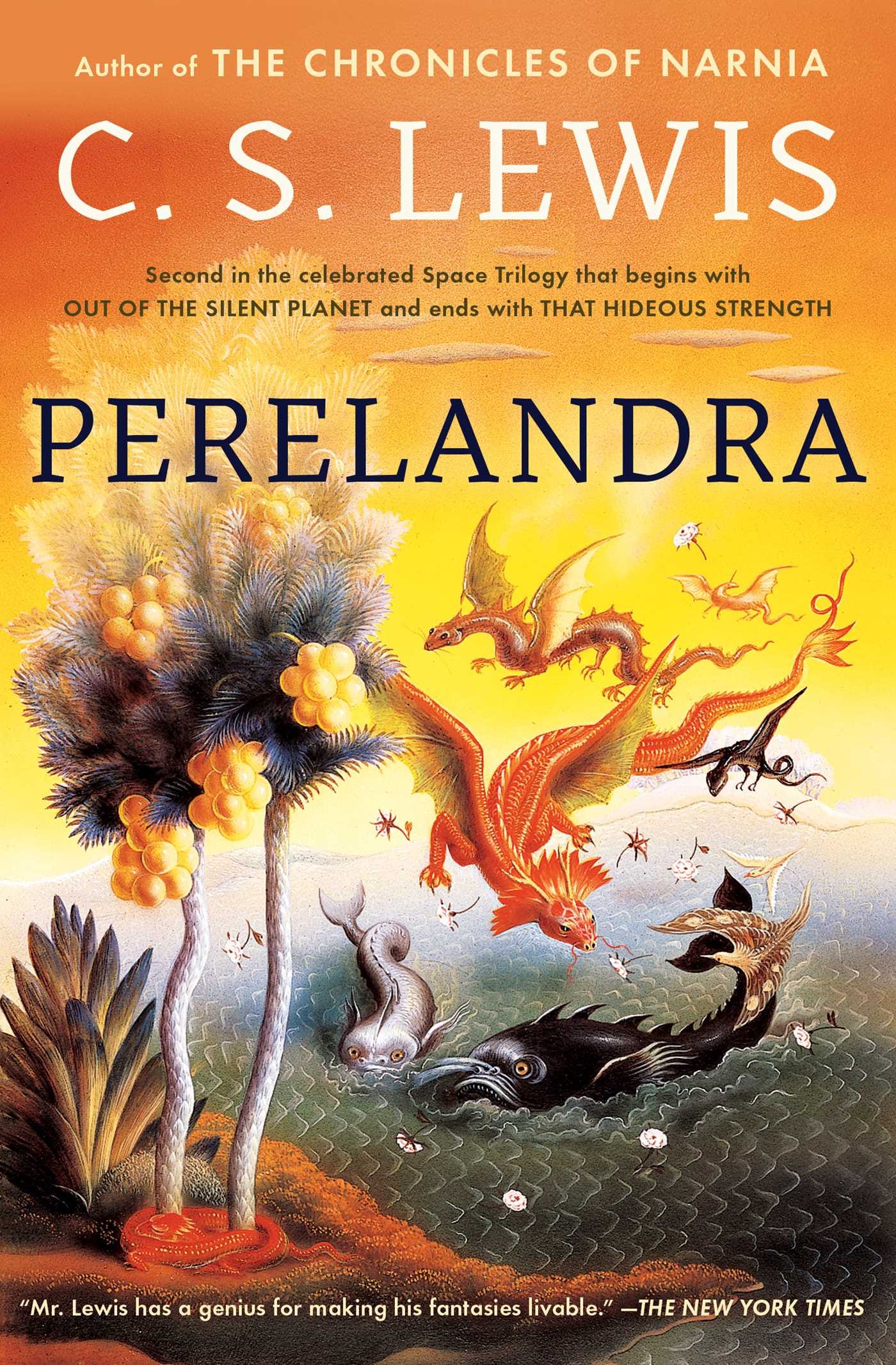
We continue now with my extended review/analysis of C.S. Lewis’ Space trilogy, the first part of which you can find here.
In a transcribed conversation from 1962, Lewis described Perelandra as the “story of an averted fall.”1
In the preceding novel in the Space trilogy, Out of the Silent Planet, Lewis presented the Martian world of Malacandra as a somewhat Eden-esque utopia, peaceful and free of most kinds of tragedy. But here in Perelandra, the titular planet (known to us as Venus) is as close to Eden as one can get without traveling through time. Here is a world decidedly without original sin, frozen at the sixth day of creation. And our hero, Elwin Ransom, has to keep it that way.
Out of the Silent Planet owed a great deal of its texture to the adventurous works of H.G. Wells and Jules Verne, but Perelanda is of a much different character. The exploration and adventure are still here, but are much more subdued. Instead, it seems to me that Perelandra owes a great deal not to adventure fiction, but to Milton’s epic Paradise Lost. I draw this comparison not simply because they’re both stories about Eden (in some form), but also because Perelandra devotes huge chunks of its page count to extended dialogues between characters (or Ransom’s long inner-monologues). It is an extremely conversational book—but very academic conversation. It is a philosophy lecture wrapped up in the skin of a science-fiction novel. And I think for some people, this element of the story will be difficult to overcome.
But before all the philosophizing, our characters must actually get to Perelandra. As teased in my review of Out of the Silent Planet, the sunward Perelandra is the next target of the malicious forces gathering in the black night between worlds. Ransom tells a fictionalized C.S. Lewis (whom, I’m realizing I didn’t mention in the last review, is the in-universe chronicler of Ransom’s adventures, like the “M.C.” of Michael Critchton’s The Andromeda Strain) that the Oyarsa of Earth is “meditating some sort of attack on Perelandra” and that Ransom has “been ordered there”2 because he knows the language of Perelandra: Old Solar. Old Solar is the language he learned on Malacandra, which conveniently also exists on Perelandra but was “lost on Thulcandra” (Earth).3 He jokes to fake-Lewis that already knowing the language “saves a lot of trouble” but “as a philologist I find it rather disappointing.”4 As readers too, we can understand the convenience here from a writer’s perspective, but it does close the door on that aspect of the discovery of Perelandra, and makes the world slightly less interesting than it could have been. But there is still one key mystery: Ransom isn’t told why he’s being sent to Perelandra, only that he is being sent.
As we talked about the contemporary conceptions of Mars in Lewis’ time, Venus was similarly veiled in mystery and speculation; and no shortage of interest amongst scientists and fiction authors. Perhaps because these are our two most nearby celestial neighbors (not including our Moon), but even Wells’ The War of the Worlds ends with the narrator concluding that perhaps the Martians would siege Venus next. It would be some thirty-ish years before the Soviet Venera probe would fly by Venus, and it wouldn’t be until the 70s that a spacecraft would actually land on Venus (and be almost immediately destroyed). Thus, in 1943, does Lewis imagine Venus as an oceanic paradise, watery and verdant. In Milton’s phrase, Lewis’ Venus is an “Illimitable ocean without bound / Without dimension, where length, breadth, and heighth / And time and place are lost.”5 Perelandra is a world fully formed, but still, to some degree, in the process of being made. The drifting islands that dot the surface of its vast ocean are decidedly impermentant. Perelandra has no continents (save for one, locked land mass: The Fixed Land, where Perelandra’s humanesque inhabitants are forbidden to dwell). No one could map Perelandra because its geography is constantly in flux. Great storms buffet the detached islands round the endless sea (perhaps inspiring Bradbury’s Venus in “The Long Rain”).6 Perelandra is in flux, not yet made but not yet unmade. The final development of Perelandra rests in the hands of its King and Queen, its Adam and Eve, to see if they will follow the same path as their Earthly counterparts or choose a better future for their world.
Perelandra’s Eve figure is the first non-animal Ransom encounters after his arrival on Venus’ watery surface. For a long time he simply knows her as “the Lady.” Her King, the world’s Adam, is on some other detached island who knows how far away, and so she and Ransom are alone for a time, in which Ransom begins to get a clearer picture of why he has been called to Perelandra. But the picture doesn’t become completely clear until another Earthling arrives: Weston, the physicist who kidnapped Ransom to Mars in the previous book, who wished to conquer Mars for humanity and wants to conquer Perelandra for… something else.
Weston, in parallel to Paradise Lost, arrives as a fallen angel, tumbling from the sky in his wayward spacecraft. He is Lucifer, arrived to tempt Perelandra’s Eve toward sin. As Ransom mused to fictional-Lewis in the early pages of the book, the malignants spirits on Earth would attempt to conquer Perelandra not through direct attack, but “in some different way.”7 Weston is that way. By Ransom’s reckoning, Weston has been sent to Perelandra “to open a new chapter of misery for the universe.”8 It gets to the point where Ransom even thinks that it would be better to be in the presence of Milton’s Satan than be in the proximity of Weston any longer.
Elaborating on ideas introduced in Out of the Silent Planet, mid-way through Perelanda Ransom further describes Weston as
a man obsessed with the idea… that humanity, having now sufficiently corrupted the planet where it arose, must at all costs contrive to seed itself over a larger area: that the vast astronomical distance which are God’s quarantine regulations, must somehow be overcome. This for a start. But beyond this lies the sweet poison of the false infinite—the wild dream that planet after planet, system after system, in the end galaxy after galaxy, can be forced to sustain, everywhere for ever, the sort of life which is contained in the loins of our own species—a dream begotten by the hatred of death upon the fear of true immortality, fondled in secret by thousands of ignorant men and hundreds who are not ignorant. The destruction or enslavement of other species in the universe, if such there are, is to these minds a welcome corollary.9
With this image in mind, any time Weston spoke, I kept finding myself picturing Elon Musk. When Weston tells Ransom that “The utility of the human race… in the long run depends rigidly on the possibility of interplanetary, and even inter-sidereal travel,”10 I could not help but recall more recent statements from Musk—such as the notion that “making consciousness multiplanetary is essential for [humanity’s] long-term survival”11 because “civilizations either expand or they die.”12 “The key of human destiny was placed in my hands,” Weston says.13
I struggle a lot with this particular idea. I love the concept of space travel. I always have. And I understand that one day, many millions or even billions of years from now, our Sun will expand and consume the whole of our solar system, annihilating any trace of humanity still living on Earth. So it makes some sense for humanity to spread itself out among the stars. But, there are psychological costs associated with such a task. And, we could argue, as Lewis does, spiritual costs.
In Robert D. Romanyshyn’s Technology as Symptom and Dream, Romanyshyn muses upon the idea that “the technological world is in a very radical way a cultural dream of reincarnation.” Continued technological advancement, like the kind needed to take humanity to other worlds, is, in Romanyshyn’s mind, “a record of our continuing debate with the fact of our incarnation and the limits it imposes, not the least of which, of course, is the fact of death.”14 Romanyshyn is not using “incarnation” here in the theological sense, but simply to express that we, as humans, are here on Earth right now, physically. And that means that one day we, as individuals and as a species, will die. What then is the extension of our collective life to other planets? And is such a continuation of the species desirable?
As in Paradise Lost, and in the Biblical narrative upon which Milton built his poem, Earth is made for humanity. It is a gift from God to us, and so He tasks us to be stewards over it. Surely an omnipotent God would know that one day the sun He put in our sky will die, but does that mean He intends for us to travel elsewhere? Maybe. But what if the reaching toward that goal supersedes our responsibility as stewards of the planet we have right now? As Romanyshyn writes:
As disturbing as it may be to recognize that our departure [from Earth] is motivated as an escape, it may be even more disturbing to realize that this connection between departure and destruction also works the other way. An earth from which we can depart, an earth from which we can escape, is one whose destruction would be less of a catastrophe. …Earth so regarded is already psychologically abandoned. The ground, literally and figuratively speaking, is already prepared for lessening the impact of destruction. …the possibility of departure from earth is a way of lessening the emotional effects of the fear of its destruction. …And feeling the need to escape, as promised in the possibility of space flight, it becomes necessary to devalue the earth we would leave behind, to lessen the impact of its loss.15
Weston has already given up on the Earth, and so seeks out new footholds for humanity among the stars. But God demands that we focus our efforts on the Earth first. Before we begin developing the technology capable of pumping clear air and clean water beneath the flimsy atmosphere of Mars or one of the Jovian moons, we must first clean our own air and clean our own water. Before we begin planting crops in the soil of faraway planets, what about addressing issues of agricultural collapse on our own? Weston, like Musk, seems to not view Earth as a gift to us from a Maker, but rather as a jumping off point to further greatness for mankind. That is the spiritual cost, abandoning what God has made for us. It is another stab at the construction of the Tower of Babel. And yet: “The world leaps forward through great men,” Weston says, “and greatness always transcends moralism.”16
But I still often wonder, in my own hesitancy to get on board with the notion of a spacefaring humanity at all costs, if I am not like that man in that joke about a hurricane: sitting on my roof as the floodwaters rise, praying to God to save me, ignoring the passing boat and helicopter because “God will save me,” only to drown and arrive in heaven to be chastised by the God who sent the boat and the helicopter to rescue me. In that example though, the house is already lost. Our house—Earth—isn’t yet, so we can’t go abandoning it.
I realize it may seem, from the amount of time I’ve spent on this point, that this is the main bulk of the action in Perelandra, but that is not the case. As Lewis himself says, this is the story of averting a fall. Most of the middle of the book then, are dialogues between Weston, Ransom, and the Lady, in which Ransom and Weston each try their best to convince her of the rightness of their side of things. Weston, of course, is trying to get the Lady to defy the commands of Maleldil, as Eve did; and Ransom is doing his best to dissuade her from that course of action, without really even having the right rhetorical framework to do so because there are so many concepts related to sin and disobedience that one who has not yet experienced them would be unable to understand (nor should be able to understand). And Ransom doesn’t want to get in the way of the Lady’s free will. He knows that this is a fulcrum point in Perelanda’s history that needs to be hers to pivot. So the Lady says, “I thought we went along paths—but it seems there are no paths. The going itself is the path.”17
In the end, rhetorical tactics fail Ransom, and more dramatic measures need to be taken. As Lewis writes elsewhere: “You cannot be sure of a good harvest whatever you do to a field. But you can be sure that if you pull up one weed that one weed will no longer be there.”18
Perelandra is fascinating, to be sure, but it will definitely not be to all tastes. It is a lot of talking, and a lot of really heady talking. But Lewis’ depiction of this fantastical version of Venus is wonderful, with all its marvelous fruiting trees, floating islands (one might imagine the art of Roger Dean, or the vast sargassum islands of our own Earth), and astounding animal life. And it is, if nothing else, providing us with a good indication of how the final book in the trilogy will go. That Hideous Strength is about as long as Out of the Silent Planet and Perelandra combined, and features a massive ensemble cast capable of doing a whole lot of talking about a whole host of deeply philosophical subjects. There is also a domesticated bear! Recalling Out of the Silent Planet though, in the latter third of Perelandra we see another flash of inspiration of H.G. Wells’ The First Men in the Moon, as Ransom is forced to traverse a labyrinth of pitch-black tunnels beneath Perelandra’s watery surface.
And before we end, I do want to highlight this one passage from Perelandra, in which I have never been more “seen” by an author. During his first days on Perelandra, Lewis describes Ransom’s “specific pleasure of plain food—the delight of munching and being nourished.”19 I get that. Sometimes you just gotta crunch on something.
Lewis, C.S. Of Other Worlds: Essays and Stories. HarperOne, 2017 (pg. 137)
Lewis, C.S. Out of the Silent Planet, Perelandra, That Hideous Strength. Quality Paperback Book Club, 1997 (pg. 177)
Ibid, pg. 179
Ibid.
Milton, John. Paradise Lost. Penguin Classics, 2000 (pg. 47). Book II: lines 892-894
Bradbury, Ray. The Illustrated Man. Simon & Schuster, 2012. Published 8 years after Perelandra, Bradbury depicts Venus as a world of endless rain, one which has a “great Single Sea” (79) and “only one continent” (85). Additionally, as is the case on Perelandra, Bradbury notes that night on his Venus “was so completely black that it was dangerous to move” (90).
Out of the Silent Planet, Perelandra, That Hideous Strength, pg. 177
Ibid, pg. 226
Ibid
Ibid, pg. 233
@elonmusk on Twitter (Aug 24, 2025)
Ibid, (Jan 19, 2025)
Out of the Silent Planet, Perelandra, That Hideous Strength, pg. 233
Romanyshyn, Robert D. Technology as Symptom and Dream. Routledge, 1990 (pg. 11)
Ibid, pg. 23-24
Out of the Silent Planet, Perelandra, That Hideous Strength, pg. 238
Ibid, pg. 216
Lewis, C.S. God in the Dock. Edited by Walter Hooper. William B Eerdmans Publishing Company, 2014 (pg. 107)
Out of the Silent Planet, Perelandra, That Hideous Strength, pg. 200