
Review: OUT OF THE SILENT PLANET by C.S. Lewis
Part 1 of the Space Trilogy

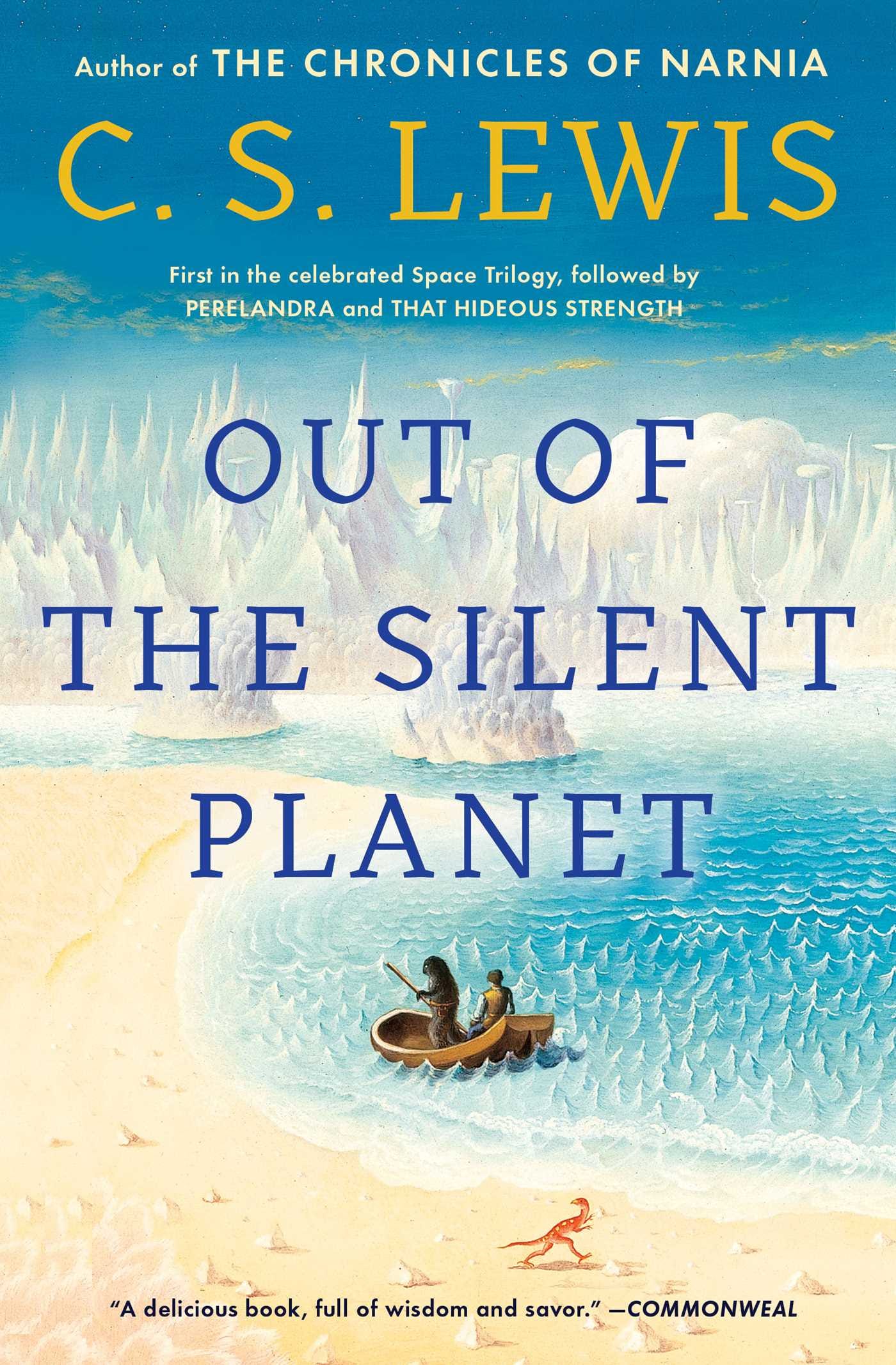
I have had C.S. Lewis’ Space trilogy on my to-do list for more than a decade now. I have all three books in one volume, which, I think, conspired to give the whole thing an intimidating aura (all three books together run more than 700 pages), so I could never quite find the motivation to actually pull the dang thing off my shelf. But, as I’ve found myself more and more flitting in and out of the world of the Incensepunk genre, it seemed like it was finally time to crack open one of the old masters: C.S. Lewis.
I’d read, of course, in my childhood, Lewis’ Narnia books, and have, as an adult, read The Screwtape Letters, Mere Christianity, and a number of Lewis’ articles and essays (collected in God in the Dock, Present Concerns, and Of Other Worlds); and so was not at all unfamiliar with Lewis as an author and a thinker. But even so, I found the works of the Space trilogy to be wholly unexpected. We (now inching closer to 100 years on from when the first of these books were published) have no real way to talk about them without trafficking in the revelation of spoilers, and so we should probably consider this series of undoubtedly long posts more as “analysis” than strict reviews. Close the page now if you’d like to remain completely in the dark prior to your own reading of these stories.
“Nothing is deader than yesterday’s science-fiction,”1 writes Arthur C. Clarke in his novel of Martian colonization: The Sands of Mars. This sentiment is expressed tongue-in-cheek-ly within Clarke’s text, but does have, for our purposes, some truth and some falsehood. In terms of literary merit, the oldness of a science-fiction book has little bearing on whether a contemporary reader might enjoy it or not. In this sense, old science-fiction works are not “dead” and never will be. But when considering the history of science-fiction and its very nature as storytelling medium, things get a little messier. We cannot separate the two halves of the genre. Fiction, conceptually, remains timeless, but science is anything but. Science is constantly being reappraised and reexamined in light of new discoveries, and so science-fiction too is constantly evolving to adapt to new paradigms. Thus, there is some argument to be made (as the argument is made in The Sands of Mars) that science-fiction works containing now-outdated scientific concepts might very well be “dead.” “It’s either purely factual… or else it’s pure fantasy,”2 says Clarke’s Captain Norden. So then, if the “science” component of a science-fiction story is shown to be false, what merit does it have? I think such a perspective misses the forest for the trees, but it does allow for an interesting jumping off point into the history of the genre. Even if the science of a given, older story appears to us today as fictional as the story written around it, understanding the time and place from which those perspectives came can provide us valuable insight into how and why authors of that era wrote the way they did. Lewis’ Out of the Silent Planet is one such book in this tradition. It is a book about Mars, or, as its inhabitants call it: Malacandra. And it is a Mars with breathable air, drinkable water, and walking-talking life upon its surface. A Mars completely divorced from real science.
Mars is and has always been a somewhat malleable setting for fiction authors. As Robert Crossly writes in his literary history of the Red Planet, Imagining Mars,
Mars is not only a locale, a symbol, a mythos, it is also a tabula rasa. It is a place with a past but without a history. …Lacking a history… Mars is an empty page on which writers can sketch a critique of things as they have been and are in our own world, a vacant stage on which alternative modes of human organization and conduct can be enacted.3
All of this prelude to say, despite the falseness of the science of Lewis’ Space trilogy, it—and particularly Out of the Silent Planet—captivated me to no end, both as an enjoyer of science-fiction and as a hobbyist historian of the genre. Lewis’ story exists near the end of a specific period of Martian fiction, when there was still some speculation that Mars might, in fact, be capable of sustaining life. Theories about the existence of water on Mars—water in designed canals—were still popular, though they were on the verge of being definitively disproven. Perhaps there was life on Mars, astronomers mused; and not just life, but intelligent life. This idea, deployed in the context Lewis does, is perhaps the most interesting element of the first two books in this series. In both Out of the Silent Planet and its direct sequel Perelandra, Lewis asks what screenwriter David Koepp does in Disclosure Day (2026), “Why would He make such a vast universe, yet save it only for us?” Though Lewis probably had a different version of this question in mind, one attributed to astronomer Johannes Kepler in the opening epigraph of Wells’ War of the Worlds: “But who shall dwell in these worlds if they be inhabited? …And how are all things made for man?”4
In Lewis’ Silent Planet, as is the case of many fictional versions of Mars, aliens occupy the Red Planet, and their home planet is rich with native flora and fauna. As far as inspirations go for Lewis’ version of Mars, perhaps none are so great as the works of H.G. Wells. Apart from real-world astronomers like Percival Lowell and Giovanni Schiaparelli, Wells was—at the time Lewis was writing Out of the Silent Planet—perhaps the foremost author of stories about Mars. Wells’ The War of the Worlds had, since its 1898 publication, dominated the English-speaking world’s cultural perception of Mars, though works like Burroughs’ 1912 A Princess of Mars certainly made their own splash in the years leading up to Lewis’ tackling of the Red Planet. Out of the Silent Planet even begins with a dedication of sorts to Wells, where Lewis informs the reader that he is not “too ungrateful to acknowledge his debt to [Wells].”5 Unsurprisingly then, Wells and his stories get explicitly name dropped multiple times throughout the story of Out of the Silent Planet (and not just as texture—they exist diegetically within the story and have been read by the characters), most clearly with the invocation of one of Wells’ characters from The First Men in the Moon.
First Men is a particularly noteworthy comparison to Silent Planet, as, in it, we can see quite keenly the influence of Wells on Lewis. Both books use a similar narrative framing device: that of a secondary character recounting the story of the primary character (a common device for Wells). Both deal with themes of the tragedy of imperialism. Both have a character attempting to learn an alien language. And both describe lush, otherworldly landscapes in places that we now know are entirely incapable of supporting such life. And it is in Lewis’ descriptions of the Martian surface that we can see the influence of both Wells’ fiction and his journalistic writing. In broad strokes, the texture of Lewis’ Mars can be seen in Wells’ imagining of the lunar surface in First Men, but in its specifics we can see the influence of such works as Wells’ 1908 article “The Things that Live on Mars” (written for Cosmopolitan, of all things). When Lewis’ Elwin Ransom explores the surface of Malacandra for the first time—having been well versed in Wells’ writing, we’re told—we can imagine how excited he must have been to see Wells’ predictions of the Martian surface come true, that, in Mars’ weaker gravity, “Martian stems and stalks will all be slenderer and finer,” and that “upon Mars… it seems reasonable to expect bigger plants there than any that grow upon the earth.”6
But how does Ransom get to Mars? Ransom is, after all, an English professor and philologist (whom friend-of-Lewis J.R.R. Tolkien insists is not a fictional version of him),7 not an astronomer or a scientist. Here too we find some influence of Wells’ First Men. Like Bedford, the narrator of First Men, it is through contact with local scientists that Ransom ends up en route to Mars. But unlike Bedford in First Men, Ransom’s travel is undertaken without his consent. He is kidnapped, and scurried away to Mars to be a sacrifice to the distant aliens. And so goes the question, as Kepler supposedly asked: “are all things made for man?”
Though Mars is the primary subject of Out of the Silent Planet, Lewis whole Space trilogy is concerned with exactly that: the whole of the cosmos. What is out there? And, more importantly, why is it out there? Is there something waiting for us in the stars? Science-fiction has long been preoccupied with the idea of mans’ place amongst the stars, here on our Pale Blue Dot—and Lewis is certainly no stranger to this preoccupation. In a talk to the Cambridge University English Club in 1955 he said that:
It is sobering and cathartic to remember, now and then, our collective smallness, our apparent isolation, the apparent indifference of nature, the slow biological, geological, and astronomical processes which may, in the long run, make many of our hopes… ridiculous. If memento mori is sauce for the individual, I do not know why the species should be spared the taste of it.8
Taken at face value, one might think Lewis is in the camp of those science-fiction authors who look upon mankind’s seeming isolation amongst the stars and see only horror, as Pascal had once mused.9 There is nothing out there, and that must be frightening. But I have left something out in the ellipsis of the above quotation. Lewis includes a parenthetical. To look upon the vastness of the universe, writes Lewis, “may, in the long run, make many of our hopes (possibly some of our fears) ridiculous” (emphasis added). That is Lewis’ intention, as I see it—that, by populating the solar system with all sorts of aliens and angelic beings and demonic influences, he would not dash our hope for the future on the rock, but dissuade our collective fears. Space should not be frightening. We get a suggestion of this more clearly in Perelandra, where one character assumes that mankind must “live always in that terror and that delight”10 of being able to see the stars at night. But Lewis reveals his own view early on, as Ransom—en-route to Mars—observes the passing vastness of space and says that “space was the wrong name. Older thinkers had been wise when they named it simply the heavens.”11
Thus, in Out of the Silent Planet, Mars is presented as a somewhat Eden-esque sanctuary set within the cosmos. The peoples of Lewis’ Mars live under a clearly Christian-adjacent worldview—clearly developed in parallel to familiar Christian traditions on Earth but not exactly the same. Mars has no Christ figure, because these beings do not need to be saved in the way that Christ saved Man. God, with the capital-G, still clearly exists here, but His development of Mars did not at all follow along the same lines as did the development of Earth. The Oyarsa, the divine spirit overseeing Mars, tells Ransom that “We are both copies of Maleldil”12 (the Old Solar word for who we would call “God”).
Ransom’s explorations of this alien world are undoubtedly the highlight of the book. Ransom is allowed to wander, literally, for many pages between key narrative beats, and Lewis spares no expense richly describing the vast and diverse biomes and inhabitants of his version of Mars. It is beautiful and mesmerizing—an unspoiled world, by all account. The inhabitants of Malacandra are all peaceful, and they welcome Ransom into their world, teaching him their languages and their sciences and their culture. Lewis takes a slight shot at Wells here, when Ransom remarks that, “The tellers of tales in our world make us think that if there is any life beyond our own air it is evil.”13 But Malacandra is not evil, and so, by the introduction of humans to this world, and with it, human sin, does Ransom find new fears (fears which will be greatly amplified in Perelandra).
One chiefly human sin at which we see Lewis take aim is that of imperialism. Right from the jump we see Lewis’ drawing comparisons between the motivations of Ransom’s captors and those of imperialists living in Lewis’ time on Earth. Ransom tells his captors, Weston and Devine:
“I suppose all that stuff about infinity and eternity means that you think you are justified in doing anything—absolutely anything—here and now on the off chance that some creatures or other descended from man as we know him may crawl about a few centuries longer in some part of the universe.”14
And later Ransom confesses to one of the Martians:
“I think [Weston] would destroy all your people to make room for our people; and then he would do the same with other worlds again. He wants our race to last for always, I think, and he hopes they will leap from world to world… always going to a new sun when an old one dies.”15
And Weston, the physicist who built the spaceship that made this whole journey possible, explicitly confirms these intentions in an argument with the ruler of Mars:
“It is in her right… the right, or, if you will, the might of Life herself, that I am prepared without flinching to plant the flag of man on the soil of Malacandra: to march on, step by step, superseding, where necessary, the lower forms of life that we find, claiming planet after planet, system after system, till our posterity—whatever stance form and yet unguessed mentality they have assumed—dwell in the universe wherever the universe is habitable.”16
Though we can assume the majority of Lewis’ ire is being leveled at the British empire, Weston’s words certainly have a familiar ring to those familiar with the American notion of Manifest Destiny. And this wasn’t and idea restricted to his fiction. In Mere Christianity he writes: “There are also occasions on which a mother’s love for her own children or a man’s love for his own country have to be suppressed or they will lead to unfairness towards other people’s children or countries.”17
But as an author of fiction, Lewis—like other authors of the time—was also not alone in his use of spacefaring fiction to explore these ideas. They are, likewise, the fears of Wells’ in The War of the Worlds (“Are we such apostles of mercy as to complain if the Martians warred in the same spirit?”)18 and of Wells’ protagonist in The First Men in the Moon. Wells’ Dr. Cavor, fearfully looking forward to to a time when he must return to Earth with evidence of his explorations of the moon (and the gold its soil holds), laments that, “Governments and powers will struggle to get hither, they will fight against one another and multiply the occasion of war. In a little while, in a very little while if I tell my secret, this planet to its deepest galleries will be strewn with human dead,”19 adding that, “It is not as though man had any use for the moon. What good would the moon be to men? Even of their own planet what have they made but a battleground and theater of infinite folly?”20
But, in contrast to the Earth of Lewis’ and Wells’ time, one which was made “a battleground and theater of infinite folly,” the world of Lewis’ Malacandra is presented, as we’ve seen, as almost utopia. But it is not a perfect world. It is not Eden. Not exactly. There have been points throughout the planet’s history when its rulers have had to dispense capital punishment to wrongdoers. Portions of the planet have died. And there is still death amongst its peoples, both natural and at the hands of Malacandra’s predators. Even so, Hyoi, one of the aliens Ransom meets in his travels, muses that, “I do not think the forest would be so bright, nor the water so warm, nor love so sweet, if there were no danger in the lakes.”21
Worse though, because of Malacandra’s seeming lack of original sin, or the consequences thereof, new kinds of death are brought there by Ransom’s companions, who slay one of the aliens with their guns (again, drawing parallels to European conquest of “savage” nations). Ransom recognizes, here and later in Perelandra, that this introduction of human sin and vice to this pristine world is its own kind of sin, its own kind of tragedy, and must be averted at all costs. And in Lewis’ mind, not only is it a tragedy for the people on whom it is conducted, but also for those participating in it. Lewis, in a response to a review of his Space trilogy, spoke more explicitly about the themes of Out of the Silent Planet, writing that he was taking aim at “the belief that the supreme moral end is the perpetuation of our own species, and that this is to be pursued even if, in the process of being fitted for survival, our species has to be stripped of all those things for which we value it,”22 echoing Christ’s words in Matthew, “For what will it profit a man if he gains the whole world and forfeits his soul?”23 And so in Out of the Silent Planet and Perelandra, Lewis expands the scope of Christ’s question: what good is it to gain the whole universe, but lose your soul? This question is only introduced in The Silent Planet, and will find its answer further along the arc of the trilogy. For now, Mars has more pressing concerns, like finding justice for the natives slain by Weston and Devine.
For all the influence of First Men in the Moon, Wells’ The War of the Worlds deserves, again, an additional mention, especially as Lewis explores the cosmology of Malacandra, which, despite its Edenic appearance, is—in Wells’ phrase—“not only more distant from life’s beginning but nearer its end.”24 The nearness of Malacandra’s end comes not from the heat death of the sun or Martian climate collapse, but because of Maladandra’s place in divine history. You see, there is a war coming—not simply to Mars, but to all the planets of our solar system. And it is coming especially to the silent planet, to Earth. Great forces are amassing amongst the stars, and Malacandra’s time is coming to a close. Its place in history has been decided. Its purpose within the heavens nearly fulfilled. And so Ransom must return home, along with Weston and Devine (mercifully left alive by the ruler of Mars, though not with certainty that they will survive the trip back) to prepare Earth for the coming battle.
But it will not immediately arrive. Ransom will be called to another field of conflict first: Earth’s other closest neighbor, the bright sunward planet Peralandra.
By way of slight spoiler for the next two portions of this review/analysis, I think I enjoyed Out of the Silent Planet the most out of the three books of the trilogy. Perelandra and That Hideous Strength are fascinating in their own right, as we’ll discuss, but the Wellsian/Vernian adventure of Out of the Silent Planet has far and away the most “entertainment value,” if such a thing matters to you. And it feels the most coherent and put together of the three novels. Ransom has the clearest arc here. The whole story begins with him being asked by a stranger to check on her son, who works for Weston and should’ve been home by now. Such action is merely a tiny mirror of the role he’ll play for the aliens of Mars, and indeed the whole of humanity.
In conclusion: those who’re familiar with Lewis’ theological or political writings, or who have read his Narnia books, will be unsurprised that both this first tome of the Space trilogy and the following two books are thematically dense and rich with ideas. These are books you can chew on for a long time after reading them. But those who aren’t looking for some hefty philosophical exploration of mankind’s place in the universe, Out of the Silent Planet will still get you plenty of bang for your buck. I can recommend it, without reservation, as a great science-fiction adventure. And it can be enjoyed entirely without ever touching the next two books, if the really hefty philosophical stuff is not your bag. And, as far the the wonderment of exploring the stars goes, some of the novelty is slightly worn off by the time Ransom travels to Perelandra in the second novel (and That Hideous Strength takes place entirely on Earth). Ransom’s exploration of Perelandra is still quite wonderful, and the landscape is divergent enough from that of Mars to not at all feel like a retread of Out of the Silent Planet, but simply by being another “man explores new planet for the first time” story, the wonder of Perelandra has lost, at least to some degree (to borrow Stanislaw Lem’s phrase) its “strange, icy sovereignty.”25
But we’ll get into all of that later…
Clarke, Arthur C. The Sands of Mars. Signet Classics, 1974 (pg. 47). Funnily enough, C.S. Lewis said something similar a few years after the publication of The Sands of Mars, that “It is only the first visit to the Moon or to Mars that is…any good.” (Of Other Worlds, pg. 103)
Ibid, pg. 48
Crossley, Robert. Imagining Mars: A Literary History. Wesleyan University Press, 2011 (pg. 16)
Wells, H.G. The War of the Worlds. Tor, 1988 (pg. 2)
Lewis, C.S. Out of the Silent Planet, Perelandra, That Hideous Strength. Quality Paperback Book Club, 1997 (pg. 7)
Wells, H.G. “The Things that Live on Mars.” Cosmopolitan, vol. XLIV, Mar. 1908, no. 4 (pg. 336)
Tolkien, J.R.R. The Letters of J.R.R. Tolkien. Edited and selected by Humphrey Carpenter with the assistance of Christopher Tolkien. HarperCollins, 2023 (pg. 127)
Lewis, C.S. Of Other Worlds: Essays and Stories. HarperOne, 2017 (pg. 104)
One of the more famous quotes attributed to Pascal goes: “The eternal silence of these infinite spaces terrifies me.” Arthur C. Clarke has a similar quote, wherein he writes that: “Two possibilities exist: either we are alone in the Universe or we are not. Both are equally terrifying.”
Out of the Silent Planet, Perelandra, That Hideous Strength, pg. 209
Ibid, pg. 34
Ibid, pg. 119
Ibid. pg. 120
Ibid, pg. 29-30
Ibid, pg. 121-122
Ibid, pg. 136
Lewis, C.S. Mere Christianity. HarperOne, 2001 (pg. 11)
The War of the Worlds, pg. 5
Wells, H.G. The First Men in the Moon. Penguin Classics, 2005 (pg. 129)
Ibid, pg. 130
Out of the Silent Planet, Perelandra, That Hideous Strength, pg. 76
Of Other Worlds, pg. 121
Matthew 16:26
The War of the Worlds, pg. 4. The Martian Oyarsa restates this almost verbatim: “But are your wise men so ignorant as not to know that Malacandra is older than your own world and nearer its death?” (138)
Lem, Stanislaw. Microworlds. Edited by Franz Rottensteiner. Harcourt Brace & Company, 1984 (pg. 204)